
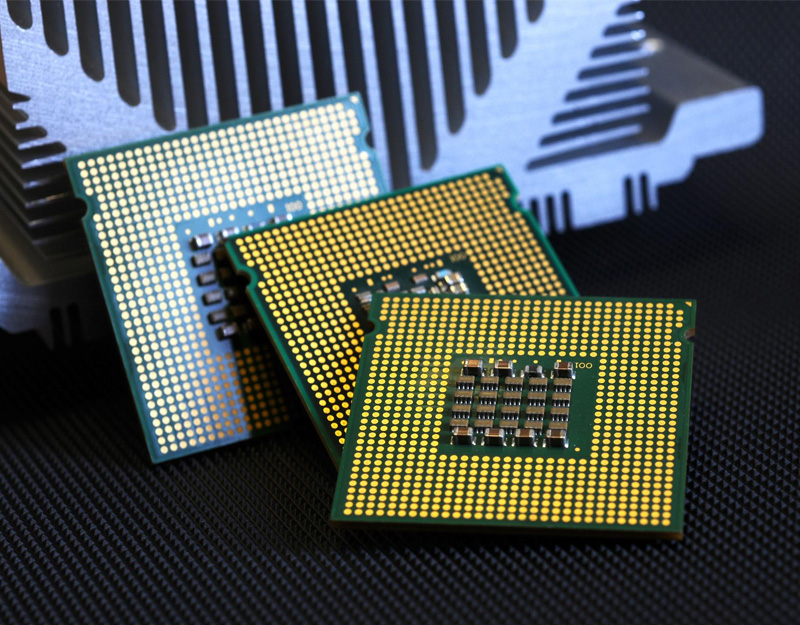
The year 2025 is one of the most exciting in the world of CPUs, as the competition between Intel and AMD has reached unprecedented levels in terms of performance, efficiency, and innovation. In the past, the race was mainly about higher clock speeds and more cores, but today it also revolves around integrating artificial intelligence technologies, supporting the latest data transfer standards, and significantly improving power efficiency.
Intel, for its part, introduced the Arrow Lake generation for desktops and Lunar Lake for laptops, focusing on combining high performance with outstanding efficiency. AMD responded with its Zen 5 architecture and its energy-efficient variant Zen 5c, in addition to enhancing its 3D V-Cache technology, which has given it a remarkable edge in gaming.
A Look at the 2025 Technological Advancements
Intel has made major improvements in power efficiency this year, cutting consumption by up to 20% compared to the Raptor Lake generation. It has also added dedicated AI processing units capable of executing over 100 trillion operations per second — a game-changer for users who work with AI-powered photo and video editing tools.
Meanwhile, AMD continued its collaboration with TSMC to manufacture processors using 3nm and 4nm processes, allowing for higher performance with lower energy consumption. Thanks to 3D V-Cache, it increased cache memory sizes to unprecedented levels, directly boosting gaming performance.
Best Intel Processors in 2025
Intel’s flagship this year is the Core Ultra 9 14900K, which combines 8 high-performance cores and 16 efficiency cores, reaching up to 6.2 GHz. This CPU shines in design, rendering workloads, and games that rely on strong single-core performance.
Another highlight is the Core Ultra 9 285K, aimed at media production professionals, offering 16 cores and 32 threads, large cache, and DDR5 support up to 8800 MHz.
For laptops, Intel introduced the Lunar Lake series, with massive efficiency improvements, integrated Xe2 graphics, and AI acceleration, making them ideal for developers and designers who need powerful processing in a portable form factor.
Best AMD Processors in 2025
On the other side, AMD’s Ryzen 9 9950X3D dominates gaming thanks to its 16 cores and 3D V-Cache technology offering up to 144 MB of cache — giving it significantly higher frame rates in CPU-bound titles.
The Ryzen 7 9800X3D with 8 cores offers excellent gaming performance at a more affordable price, while the Ryzen 5 7800X3D is perfect for 1440p and high refresh rate gaming, balancing performance and cost.
In laptops, AMD impressed with its Strix Halo processors featuring integrated RDNA 3.5 graphics, capable of competing with some dedicated GPUs like the RTX 4060 Laptop, making them an appealing choice for portable gaming.
Gaming Performance
AMD leads in most 1080p gaming benchmarks thanks to 3D V-Cache, showing up to 25% higher frame rates over Intel competitors in titles like Counter-Strike 2 and Starfield. Intel, however, shows its strength more at 4K gaming, especially when paired with high-end GPUs like the RTX 5090, where high core frequencies deliver consistent performance in complex scenes.
Productivity and Content Creation
In productivity workloads, Intel stands out thanks to its built-in AI acceleration units, offering clear advantages in video editing and design software, particularly AI-driven apps like Adobe Premiere Pro and DaVinci Resolve.
AMD, with its strong multi-core performance, excels in 3D rendering and scientific simulations, making it the top choice for designers using tools like Blender and Maya.
Power Efficiency and Thermal Management
AMD has made notable progress with Zen 5, reducing power consumption by up to 20% compared to Zen 4 while keeping temperatures lower even under full load.
Intel processors still consume more power at maximum performance but maintain relatively stable temperatures with proper high-end cooling solutions, making them suitable for sustained heavy workloads.
Pricing and Market Value
AMD processors tend to be around 10–15% cheaper than equivalent Intel chips, giving them an advantage for users seeking the best price-to-performance ratio. Intel, however, justifies its higher prices with cutting-edge features, especially in AI acceleration and single-core performance.
Market Trends Going Forward
In the coming years, AI acceleration units are expected to become standard across all processor categories, from desktops to mobile devices. By 2027, we might see 2nm process nodes, enabling huge leaps in performance and efficiency.
AMD is likely to keep supporting the AM5 platform for multiple future generations, allowing users to upgrade without changing motherboards. Intel, on the other hand, might continue to change platforms more frequently, which could be either a benefit or a drawback depending on the user’s perspective.
Conclusion
2025 is not just another year in the CPU race — it’s a major step into a new era of intelligent computing. For professional gamers who want maximum performance in games, AMD delivers the best option through its 3D V-Cache processors. For content creators and developers who rely on AI acceleration, Intel’s CPUs with advanced NPUs are an excellent choice.
Ultimately, the best choice depends on your usage and budget, but one thing is certain — both companies have released outstanding products in 2025, making the consumer the real winner.
