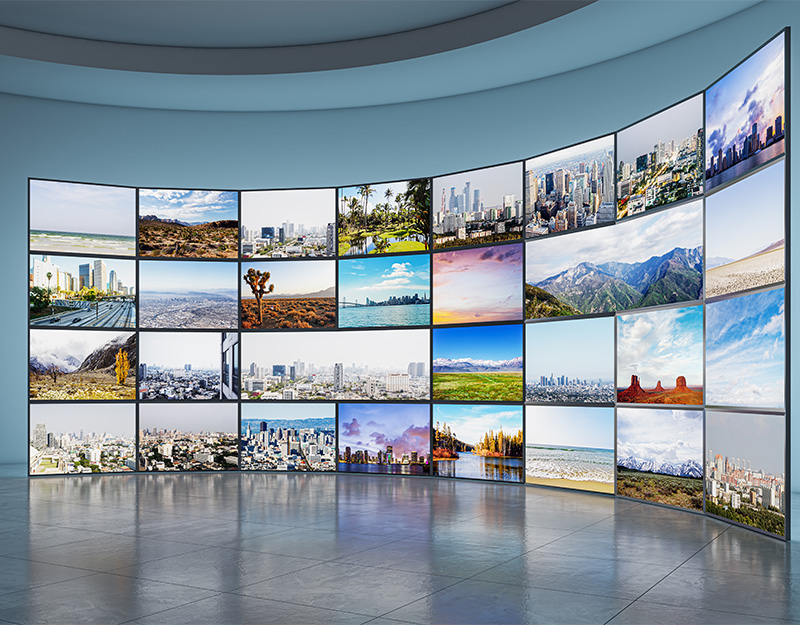
In our era, we have all witnessed a qualitative shift in the world of technology, which knows no bounds when it comes to innovation. It has become a series of technological advancements that loom on the horizon, and over time, many innovations have turned out to be fleeting trends that faded away. However, some have managed to succeed and become the talk of the town among consumers and technology enthusiasts recently. Among the most prominent of these are curved screens, which have taken center stage today, becoming the focal point of essential discussions among visual experience enthusiasts. Do you believe that this type of screen will provide us with an experience that surpasses previous ones? Or will it simply become a passing trend without adding any real value or lasting impact?
Does curvature reshape the standards of innovation and aesthetics in the design process?
Imagine yourself in front of a modern design that was not available before, where the details wrap around you as you view different images, and a world of colors and dimensions immerses you in a profound feeling as if you are part of the scene. All of this leads us to the realm of curved screens that allow us to deeply experience something like never before.
On the other side of the traditional flat screens, we were content with a visible image, limited to two dimensions. All of this leads us to compare curved screens and flat screens in terms of structure and experience:
First | In terms of shape and design:
- Flat Screens: Thanks to their traditional and flat design, this type of screen remains at the same level from all angles.
- Curved Screens: They feature inward-curving edges, as if they are trying to wrap around us to provide an unparalleled viewing experience.
Secondly | In terms of viewing angle:
- Flat screens: This type of screen offers a wide viewing angle, but when viewed from other sides, you notice that the image becomes less aesthetically pleasing and the colors more contrasted.
- Curved screens: These screens provide a consistent viewing angle from various positions, offering a complete visual experience without noticeable contrast.
Thirdly | In terms of viewing experience:
- Flat screens: They provide a superficial viewing experience because the screen is at the same level as the eyes, which reduces the immersion in the experience.
- Curved screens: They enhance the experience as they immerse the viewer in the content more, as if the screen wraps around them to provide an enjoyable experience.
Fourthly | In terms of visual strain:
- Flat screens: Sitting close to this type of screen can cause visual strain when viewed for extended periods.
- Curved screens: The alignment of the image with natural vision reduces the need for the eyes to move continuously when using this type of screen.
Fifthly | In terms of image quality:
- Flat screens: Have you ever wondered why colors vary when viewed from side angles on these screens? Certainly, because image quality depends on two technologies: OLED or LCD, which is one of the challenges facing flat screens.
- Curved screens: They provide a balanced visual experience centered on the curved screen, enhancing both image clarity and color contrast simultaneously.
Sixthly | In terms of usage:
- Flat screens: They are one of the most commonly used traditional options among people, suitable for all types of rooms.
- Curved screens: They are best placed in spacious areas and locations that require close viewing, such as: game rooms, movie theaters, and others.
In the end, the difference between flat screens and curved screens may seem simple at first glance, but it has led to significant transformations through the curvature that has changed the rules of the game in favor of curved screens. They combine aesthetics and practicality at the same time; they are not just a beautiful design but have become a technical concept that places us at the heart of the action. No matter how superficial the world may seem, our vision of it should be like the perspective provided by curved screens to the viewer.
Beyond Curved Screens
When discussing image quality, we cannot ignore the secrets of curved screens that lie in advanced display technologies, particularly in OLED and QLED. These technologies help integrate this type of screen, allowing the scene to blend deeply with the moment of the experience being presented. With OLED technology, it enhances color contrast levels, as if bringing life with it by turning off the pixels responsible for achieving perfect blacks on those screens. As for QLED technology, it aids in the purity and brilliance of colors beyond imagination.
When we talk about the immersive experience in the world of gaming or movies, it’s clear that these screens are not limited to image quality alone. The high refresh rates and precise motion make every scene flow as if you are a part of it, elevating the experience to new levels of excitement and enjoyment.
And it’s certain that it doesn’t stop here, as there are additional features: HDR responsible for color gradations in all their details, while 4K and 8K technologies take you to image details like you’ve never seen before. All these features transport us from our current reality to another reality filled with details waiting for us to discover with our senses.
Between the Idealism of Curved Screens and Their Challenges
Like any new technology that leads the world of tech, curved screens come with a set of advantages that showcase their idealism, along with challenges they may face. All of this is worth knowing to make an informed purchasing decision.
The idealism of curved screens lies in their features, as their unique curvature allows for an immersive experience in terms of image quality on one hand and a harmonious experience with the displayed content on the other. This results in vibrant colors and clearer details in the image, enhancing the viewer’s experience.
Despite their multiple advantages, they are not without flaws. One of the biggest challenges viewers may face is visibility from multiple angles, which can affect visual quality. Additionally, their costs are often higher than their counterparts, and the limited size options of some types of curved screens can make users hesitant to purchase them.
Therefore, it is important for each individual to weigh the advantages and disadvantages of these screens to determine whether they meet their needs and are worth the investment.
Practical Applications of Curved Screens
These screens have become influential beyond the realm of entertainment, extending to enhance work experience and productivity in the workplace.
Some applications that utilize this type of screen include:
- Gaming and Entertainment:
The design of curved screens enhances image quality by reducing visual distraction and glare, contributing to a greater enjoyment of its details and audio. Additionally, it provides clarity in motion details, making the surrounding environment appear more realistic.
- Work and Productivity:
Here, a noticeable benefit lies in improving the field of vision without the need to move the head and eyes repeatedly. The curvature allows for opening multiple windows simultaneously, which helps organize information to the extent possible, enhancing the efficiency of professionals who spend long hours in front of the screen.
All these benefits offered by curved screens make them a good choice for anyone looking to enhance their visual and practical experience in various daily applications.
Are curved screens a smart investment or just a luxury?
Since curved screens have become an important part of the commercial market, many users are questioning the economic feasibility of these screens. Do they really deserve the investment?
There are three factors that answer these questions:
- Cost vs. Technology:
When comparing the prices of curved screens to flat screens, we see that price is a fundamental factor in the purchasing decision. It has become clear that curved screens are more expensive than flat screens due to the complex and specialized technologies used in their manufacturing. In contrast, flat screens have a lower cost because of the simplicity of the technologies used in their production. Often, we notice that consumers seek to obtain real value regardless of their budget.
- Cost vs. Benefit:
Curved screens offer multiple benefits, such as providing an unparalleled experience, reducing glare and image distortion, and the ability to interact with content. This is considered an important feature and great value for gaming, entertainment, and movie enthusiasts looking to invest in them. However, for those who use screens for basic purposes, the benefit may not justify the higher cost.
- Sustainable Investment that Retains Value:
When considering sustainable investment, we find that investing in curved screens differs from investing in flat screens, as they tend to have lower resale value in the future due to being a modern technology that dominated the commercial markets in a short time. The demand for this type of screen may be very limited. In contrast, flat screens are more traditional, popular, and widespread in the markets. However, this theory could change if curved screens continue to develop and become a standout investment rather than just a product offered for sale later.
In conclusion, a complete understanding of these factors is essential in the process of investing in curved screens.
Are curved screens a temporary innovation or a permanent future?
By reviewing current market trends, future directions, and expert opinions, we can answer this important question around which the article revolves. Additionally, we will explore whether these screens will continue to attract attention or fade away over time with the emergence of another new technology in this field.
- Trends of Curved Screens in the Current Market:
Curved screens have recently seen increasing popularity in the markets, and it is expected that these trends will continue to grow due to the rising demand from gaming and movie enthusiasts. However, this trend will not remain constant, as the market is dynamic and ever-changing, and at any moment, a new technology could emerge that surpasses these screens and affects the sustainability of their trend.
- Future Trends for Curved Screens:
Thanks to the continuous advancements in manufacturing technology and ongoing improvements in design and performance, there may be promising future trends that make curved screens more widespread than ever before. However, it is essential to monitor the developments in various technologies that could pose a significant challenge to curved screens.
- Expert Opinions on the Future of Curved Screens:
Experts believe that continuous innovation in this field will determine the longevity of curved screens as a major trend in the market. Some argue that the ongoing advancements these screens undergo could play a significant role in the dominance of curved screens over other types in the market. Others believe that once a new technological innovation emerges, these screens will become a passing trend that changes with the evolution of advanced visual experiences.
In short, the future of curved screens depends on their development in the technical and industrial fields, as well as changes in user preferences and experiences. Their future remains uncertain and unclear, and they may become just a link in this chain of innovations.
At the end of the article, we detailed various aspects of curved screens by comparing them with flat screens across many factors. We also clarified the main technologies used in their manufacturing, discussed their wonderful advantages, as well as the challenges we, as users, might face, and the practical applications they can support, and whether they are truly worth investing in.
Looking at everything presented, it is clear that the survival of curved screens as a major trend depends on technological advancements and market preferences.
Share your opinions and experiences with curved screens, and be part of the valuable discussion about the future of this amazing technology.