
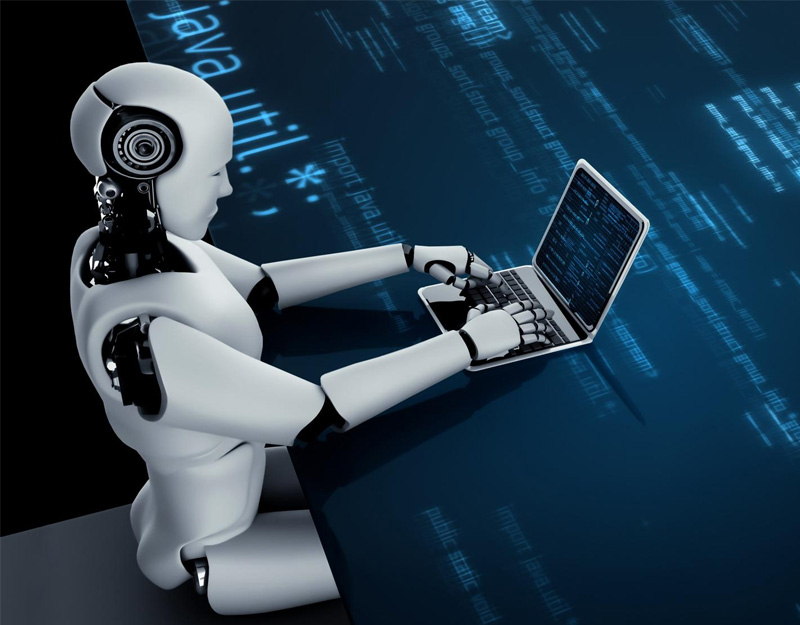
The world of software development is undergoing a profound transformation driven by the revolution of Artificial Intelligence (AI) — a technology that has evolved from being a supportive tool to becoming a core force reshaping how software is built, managed, and tested.
In the past, programming relied entirely on human effort and technical expertise. Today, it has become a collaborative process between humans and intelligent systems. With AI entering the development lifecycle, developers can now achieve faster performance, higher quality, and lower costs, driving organizations toward a more efficient and innovative digital future.
1. The Relationship Between Artificial Intelligence and Software Development
Artificial intelligence is a branch of computer science that enables machines to simulate human capabilities such as learning, reasoning, and decision-making.
In software development, AI is used to analyze code, suggest solutions, detect bugs, and even write portions of code automatically.
This integration between AI and programming not only accelerates development but also improves software quality and minimizes human errors, resulting in more stable and secure systems.
2. How AI Transforms the Software Development Lifecycle
Software development typically goes through multiple stages: planning, design, coding, testing, and deployment.
Each of these stages is now supported by AI-powered tools and algorithms, making the process more efficient and intelligent.
a. Planning and Analysis
At this stage, organizations use AI tools to analyze project requirements and user behavior.
Machine learning algorithms, for instance, can analyze user feedback and reviews to identify desired features for upcoming releases.
AI also helps in estimating timelines, predicting challenges, and allocating resources more accurately.
b. Design
AI-driven design tools assist in creating optimized user interfaces (UI/UX) based on behavior analytics.
These systems can generate layouts and design concepts automatically using proven design patterns, reducing design time while improving user satisfaction.
c. Coding
Here lies the most significant impact of AI.
Developers now have intelligent assistants such as GitHub Copilot and Tabnine, which use deep learning models to generate code automatically based on simple written instructions.
These tools not only save time but also reduce syntax and logical errors, as they learn from millions of open-source code repositories to suggest optimal solutions.
d. Testing
Testing is often one of the most time-consuming phases of development.
AI enables automated testing through code analysis and bug prediction before the software even goes live.
Pattern recognition algorithms can detect vulnerabilities and propose fixes in advance, improving product quality and minimizing maintenance costs.
e. Deployment and Maintenance
Even after deployment, AI continues to play a crucial role by monitoring performance in real-time and analyzing user interactions.
These intelligent systems predict potential failures and recommend continuous improvements, turning software development into an ongoing process of optimization.
3. Leading AI Tools in Software Development
The rise of AI has introduced several powerful tools that simplify developers’ work and elevate software quality. Below are some of the most impactful ones:
1. GitHub Copilot
A smart programming assistant from Microsoft powered by GPT models, capable of understanding project context and generating relevant code snippets that align with the developer’s style.
2. Tabnine
One of the first AI tools to provide predictive code completion. It learns from thousands of public codebases to anticipate what developers need to write next.
3. DeepCode
Uses machine learning to scan codebases, detect bugs, and highlight security issues. It provides developers with smart insights on how to make their code cleaner and more secure.
4. Kite
Offers intelligent code suggestions across more than 16 programming languages. It analyzes open-source projects to recommend commonly used and efficient solutions.
5. Amazon CodeWhisperer
An AI-based code recommendation service by Amazon Web Services (AWS), designed to accelerate cloud application development by generating real-time code suggestions.
4. Predictive Programming with Artificial Intelligence
One of AI’s most remarkable contributions to software development is predictive programming — the ability to foresee potential issues before they occur.
By analyzing historical performance data and coding patterns, AI systems can identify areas where bugs or performance bottlenecks are likely to appear.
They can also provide proactive recommendations, such as optimizing database queries or restructuring code logic to prevent system failures.
This predictive capability marks a paradigm shift in development — transforming it from a reactive process into a preventive and intelligent discipline.
5. AI in Software Testing and Quality Assurance
AI has revolutionized software testing by automating repetitive tasks and saving time.
Instead of manually writing test scenarios, AI-powered tools can automatically generate test cases based on the project’s requirements and code structure.
Moreover, AI-driven testing frameworks can identify performance weaknesses and scalability issues by simulating thousands of users simultaneously.
Machine learning testing helps forecast failure scenarios, ensuring better reliability and long-term stability of software products.
6. Benefits of Using AI in Software Development
Integrating AI into the development process brings numerous strategic advantages:
-
Faster development cycles: Automation and predictive tools reduce development time by up to 40%.
-
Higher quality and fewer bugs: Intelligent analysis helps catch and fix issues early.
-
Reduced costs: Automation decreases the need for large teams and saves human resources.
-
Improved developer productivity: AI minimizes repetitive tasks, allowing developers to focus on creativity.
-
Enhanced security: Continuous code analysis prevents vulnerabilities and compliance risks.
7. Challenges of Implementing AI in Software Development
Despite its many benefits, AI integration presents certain challenges:
-
Overreliance on AI tools, which may lead to skill degradation among developers.
-
Data privacy concerns, as some tools require access to source code.
-
Algorithmic bias, since models may be trained on limited or biased data.
-
Resistance to adoption, especially within traditional organizations unfamiliar with AI technologies.
To overcome these barriers, businesses should adopt a balanced strategy, combining AI-driven automation with human oversight and expertise.
8. The Future of AI in Software Development
The future of software development is moving toward full intelligent automation.
AI systems will soon be capable of designing, writing, testing, and deploying software with minimal human intervention.
Generative AI will enable developers to create entire applications through natural language prompts.
As a result, the role of developers will evolve from code writers to strategic supervisors guiding and validating AI-generated results.
9. The Role of Technology Companies in Driving Innovation
Leading technology companies such as AlNahl are at the forefront of empowering organizations to embrace digital transformation through AI-powered development and infrastructure solutions.
By providing intelligent tools, training, and technical support, companies like AlNahl help businesses enhance operational efficiency and accelerate their journey toward a smarter digital future.
Organizations that invest today in AI-powered software development will be the leaders of tomorrow’s competitive landscape.
Conclusion
Artificial intelligence is not just a supporting tool — it is a strategic partner in building the digital future.
It has redefined how developers think, innovate, and create, transforming software development into a faster, smarter, and more reliable process.
As AI tools continue to evolve, the digital landscape will become more dynamic and agile.
Organizations that start integrating AI today will lead the transformation tomorrow — achieving greater innovation, efficiency, and sustainability.
